Sunpatch find the light for your plants

Free houseplant light calculator

Map the light in your room.

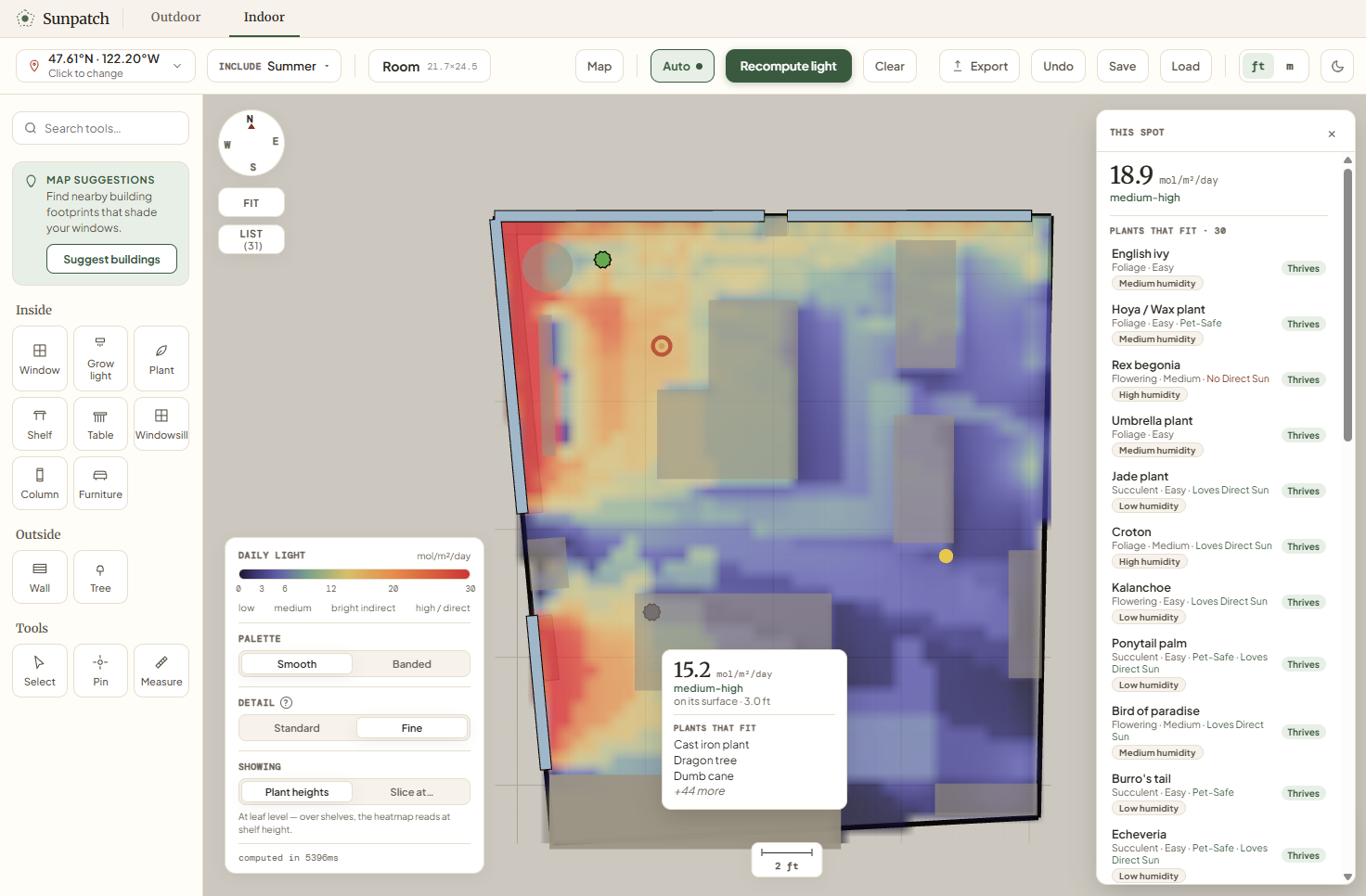
Sunpatch is a free, lightweight way to see how much light reaches each spot in a room, then match houseplants to the places they'll thrive. Sketch the room, drop in your windows, and it traces the sun across the day and season to build a daily-light map. No sensor, no account, no 3D modeling.

  • Free to use
  • No account required
  • Daily light (DLI) map
  • 117-plant database
  • Pet-safe filter
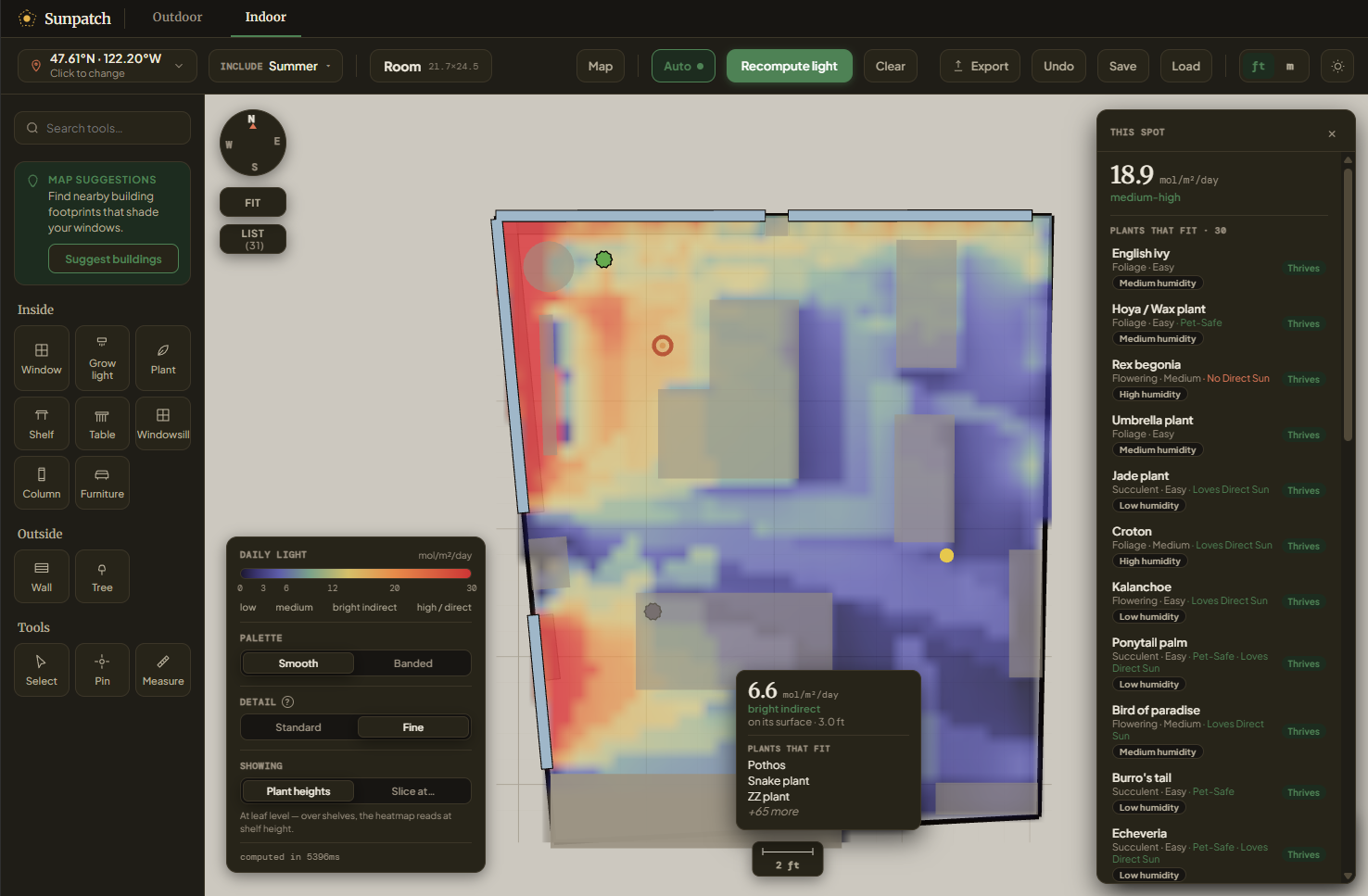
Sunpatch showing a daily-light heatmap across a top-down room layout, with windows along one wall and houseplant suggestions for the pinned spot Sunpatch in dark mode showing a daily-light heatmap across a top-down room layout, with windows along one wall and houseplant suggestions for the pinned spot

Why light is the make-or-break for houseplants

Human eyes are amazing at detecting light. So amazing, in fact, that a room that looks brightly lit to us might feel like a deep cave to a plant. It gets more confusing: care tags say things like bright indirect light, yet a real room is a gradient: bright at the glass, fading fast as you step back, and different at every window. A quick light map turns that guesswork into something you can plan around.

See the room as a light gradient

The same room can feature a sunbathing spot and a dim corner a few feet apart. A map shows where the light actually lands, so a fern and a cactus each end up where they belong.

Match plants to spots, not guesses

Pin any spot and Sunpatch lists the houseplants that thrive there, with notes on direct-sun tolerance, humidity, pet safety, and difficulty, drawn from a 117-plant database.

Plan before you buy

Find out a windowsill is too bright for a calathea - or too dim for a succulent - before it's sulking on your shelf, not after.

How to use Sunpatch as a houseplant light calculator

The goal is simple: see how much light each part of your room gets, then put plants where they'll do well. You don't need a light sensor, an account, or any 3D modeling to start.

Set your location

The sun's height and path depend on your latitude and the season, so start where the room actually is.

Draw the room and windows

Block out the room, then place each window. Direction, size, and glass type all shape how much light gets in.

Compute the light

Sunpatch traces the sun all day across the seasons to map daily light (DLI) at every spot, and folds in any grow lights you add.

Place plants by light

Drop a plant to check its fit, or pin a spot to see which houseplants would thrive, tolerate, or struggle there.

What is DLI, and how much light do houseplants need?

Plant tags talk in vague labels; growers talk in DLI - the Daily Light Integral, or the total amount of light a spot receives in a day (measured in mol/m²/day). It rolls brightness and hours into one honest number, which is exactly what a plant cares about. Here's roughly how indoor spots stack up:

  • Very low · under 3A deep interior corner, far from any window. Only the toughest survivors - snake plant, ZZ, pothos - hold on.
  • Low to medium · 3 to 6A few feet back, or beside a shaded north window. Cast-iron plant, peace lily, and many ferns are content.
  • Bright indirect · 6 to 12The houseplant sweet spot: near a bright window but out of the direct beams. Most foliage thrives here.
  • Bright with some direct · 12 to 20Right at a sunny window. Succulents, citrus, and most flowering plants want this much.
  • Indoor full sun · 20+A south-facing sill in summer. Cacti, aloe, and Mediterranean herbs soak it up.

Houseplant light questions a room map can answer

Sunpatch is built for the everyday "will this plant be happy here?" decisions.

Which window is best for houseplants?

In the northern hemisphere, south windows give the most light and the longest day, east windows offer gentle morning sun, west windows bring strong afternoon heat, and north windows stay soft and low. Sunpatch maps each one for your latitude.

How do I know if a spot is too dark?

Leggy, stretched stems, small pale leaves, and stalled growth are the classic signs. The map flags spots that fall below a plant's minimum light before they start to decline.

Do grow lights help?

A lot. Add a grow light in Sunpatch and it folds into the same daily-light total, so you can see exactly how much it lifts a dim shelf or winter window. Pro tip: you'll probably want the bulb closer to your plants than you think. (Sunpatch lets you tinker with that, too!)

Why is my plant by a bright window still struggling?

Light falls off quickly with distance from the glass, and curtains, screens, and tinted windows cut it further. The map shows that drop-off, and whether a spot tips into "too much" direct sun for a tender plant.

Are these plants safe for pets?

Every plant in the database is flagged for pet and human safety, so you can filter a spot's suggestions down to the ones that are safe around cats, dogs, and kids.

Planning an outdoor garden too?

Sunpatch does yards as well. The garden sun planner maps sun and shade across an outdoor space the same way, for beds, borders, and containers.

Start with the light, then pick the plants.

Open Sunpatch, sketch your room, and let the daily-light map show you where each houseplant belongs.

Open the houseplant light map